At Hay Festival this weekend, the River Wye was granted legal rights to flourish and be free from pollution. Walking a river I love, I find a thirteenth-century Buddhist teacher has something unexpected to say about what that really means.
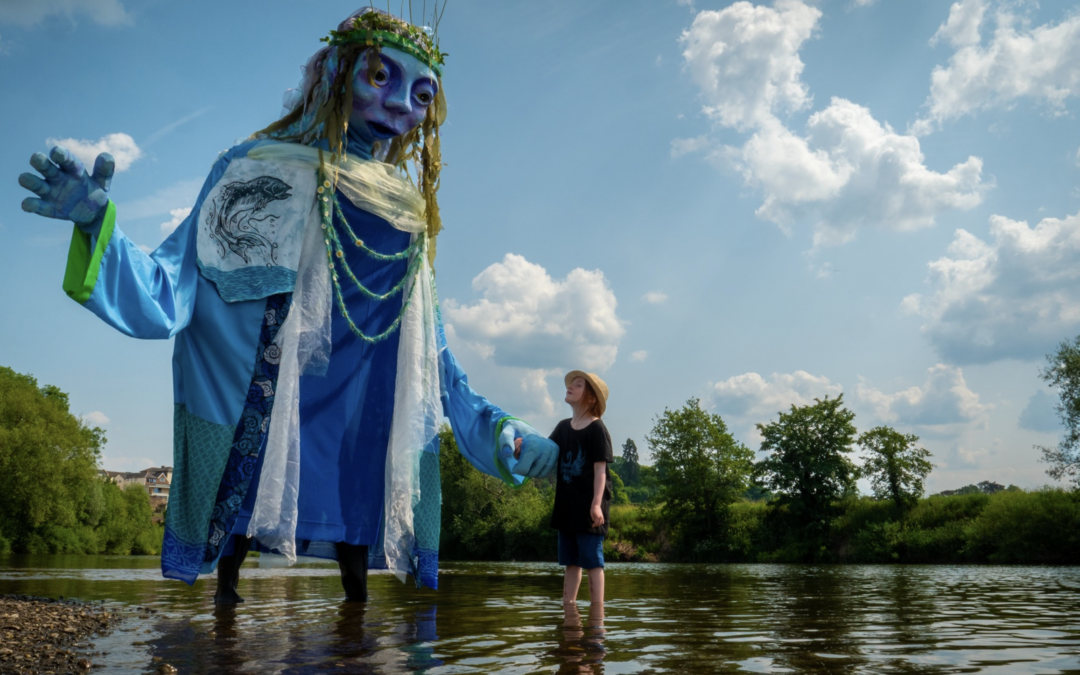
An odd group gathered in May 2026 at the Hay Festival for a simple but moving ceremony. Local authority officials joined storytellers and puppeteers beside the River Wye to launch a charter declaring that the river has rights – rights to perform its natural functions and be free from pollution. It’s the latest expression of a global movement demanding that the law sees ecosystems as living entities rather than human property.
I love walking the Wye. It winds 150 miles along the Wales-England border through lush pastures and rocky gorges. Yet, there are concerns that some industrial farming practices – while not necessarily illegal – are poIluting the river, and species like salmon and native crayfish are disappearing.
The charter recognises an ecologist as the river’s official representative at river management meetings. The Wye can’t tell us what it wants, so she’s charged to present what the river needs to flourish, setting aside human interests and preferences.
This legal arrangement gives form to something we’ve long felt but struggled to enact. The poet William Wordsworth, who celebrated the Wye, sensed that people and rivers belong to something more fundamental, "more deeply interfused" as he writes in the poem Tintern Abbey. But I think it’s the thirteenth century Japanese Buddhist teacher Dōgen Zenji who saw most clearly what that perception really means.
Dōgen knew that a river can be seen as a resource, a place of inspiration, and presumably it’s something else to the fish. But all these perceptions fall short of a more elusive reality. As Dōgen writes, “It's not only that there is water in the world, but there’s a world in water.”
We typically live as though we were separate — each of us the centre of our own world, bending what surrounds us to our interests. Buddhism calls this the core delusion and the source of our suffering. So our response to nature is also a call to look at ourselves more deeply, asking not just whether a river is alive, but what it means for us to be alive, within a vast universe on which we entirely depend.
The Wye is one of the most loved rivers in Britain, and one of the most damaged. The charter gives it rights. But the rights of nature return to us as duties of attention, restraint, and repair — not just in beautiful places, but at every point where our lives touch the world that sustains them.
I love this is happening. Inspired for all rivers and water beings that deserve their rights. The Q’ERO tradition talk of living energy which we are all a part and nature beings with their unique gifts and personalities (like humans) – the rivers can talk… they all can…